If your organization has been restructured more than once in the last five years, consider what that pattern is telling you. Not about your markets, your competitors, or your strategy, but about your organization itself.
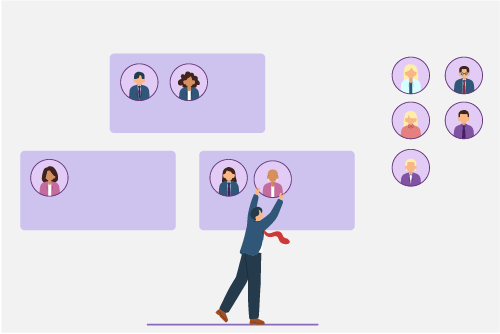
Restructuring has become the default response to strategic uncertainty. When results disappoint, when priorities shift, when leadership changes, the org chart gets redrawn. New boxes. New reporting lines. New names on the doors. And for a few months, there is the comforting sensation of motion, the feeling that something real is happening.
But motion is not progress. And the evidence is accumulating that serial restructuring does more damage than it resolves.
When an organization restructures repeatedly, it isn’t solving a problem. It’s announcing that it hasn’t learned from the last time it tried.
The Reorg as Confession
Every reorganization carries an implicit admission: the last structure wasn’t working. That is sometimes true. But when reorgs happen every 18 months, or 12, or six, the structure itself is no longer the problem. The problem is the reflex.
Restructuring disrupts everything it touches. Relationships built over years are severed overnight. Informal networks that actually move work through the organization, the ones that don’t show up on any chart are fractured. Institutional knowledge walks out the door or gets buried in new role confusion. People spend months recalibrating, figuring out who to talk to, who now owns what, and whether their priorities have changed. During that time, value delivery slows. Customer relationships suffer. Strategic momentum stalls.
And yet, the next reorg is already being planned.
This is the trap: each restructuring creates the conditions that seem to justify the next one. The dysfunction doesn’t go away. It just changes shape.
What Restructuring Can’t Fix
The uncomfortable truth is that most of what organizations try to fix through restructuring isn’t a structural problem at all. It’s a clarity problem.
When teams aren’t collaborating effectively, the temptation is to redraw boundaries. But proximity on a chart does not create collaboration. What creates collaboration is shared purpose, clear accountability, and the psychological safety to work across perceived boundaries. None of those things come from a new org design.
When strategic priorities aren’t being executed, the instinct is to create new functions or consolidate old ones. But execution doesn’t fail because of how boxes are arranged. It fails because people don’t understand what matters most, don’t have the authority to act on it, or don’t believe the stated priorities reflect what leadership actually values. A reorg changes the map. It doesn’t change the territory.
The Alternative: Organize Around Impact
There is a better organizing principle, and it starts with a shift in how leaders think about structure itself. Structure is not the foundation of an organization. It is a tool, one that should serve strategy, not substitute for it.
Organizations that break the reorg cycle don’t abandon structure. They make it subordinate to outcomes. They ask: what is the most important thing we are trying to achieve right now, and how do we align our people, resources, and decision-making to get there? And when the answer to that question changes, as it inevitably will, they shift focus, not org charts.
This is what it means to organize around impact. Rather than defining an employee’s identity by their function or business unit, impact-oriented organizations define it by the value they are creating. Teams form around outcomes. Accountability is tied to results, not to reporting lines. Cross-functional collaboration isn’t a special project, it’s the default operating mode.
Silos collapse naturally.
When people are organized around shared outcomes rather than functional territories, the incentive to protect turf diminishes. There is no ‘their problem’ — only our result.
Priorities can shift without upheaval.
When the structure is built around value delivery rather than fixed functions, reallocating focus to a new strategic priority doesn’t require a reorganization. It requires a conversation.
Accountability becomes visible.
In impact-oriented structures, it is clear who is responsible for what outcome, not which team owns which process. That clarity accelerates decision-making and surfaces problems before they become crises.
The organization learns.
When teams are continuously focused on outcomes, they build feedback loops. They understand what is working, what isn’t, and why. That knowledge compounds. It doesn’t have to be rebuilt every time leadership changes.
Stability That Evolves
The goal is not a static organization. Static organizations don’t survive. The goal is a stable organization, one with enough structural continuity that relationships, knowledge, and momentum can accumulate, while remaining genuinely adaptive to changing conditions.
That kind of stability comes not from locking down the org chart, but from building shared clarity about what the organization is trying to achieve and why. When that clarity exists at every level, people can reorient themselves as priorities shift without waiting for a reorg to tell them what to do next.
The most resilient organizations in any market are not the ones that restructure fastest. They are the ones that have built the internal alignment and adaptive capacity to redirect effort without dismantling what they have built. They compete on their ability to learn and adjust, not on their willingness to blow up the org and start over.
The reorg cycle is a choice. It persists because restructuring feels decisive, it looks like action, and it diffuses accountability by creating a new context in which past failures can be set aside. But the organizations that win over time are not the ones that restructure most boldly. They are the ones that learn most consistently.
Build structures that serve outcomes. Organize around impact. Give your people a stable foundation and a clear direction, and trust them to move when it matters, without waiting for the next reorg to tell them where to go.
Reorgs feel decisive. Learning is what actually works.
If you’re ready to build an organization that adapts without constant upheaval, let’s talk.

Adam is a Senior Consulting Associate of Strategy Management Group/Balanced Scorecard Institute and a business strategy and digital transformation leader with over 15 years of consulting experience driving solutions and has served in management & leadership positions. Adam has a history of solving challenging, global process problems by applying appropriate agile and lean adaptive frameworks to drive recommendations. In addition, he has led various collaborative projects that made his recommendations a reality.