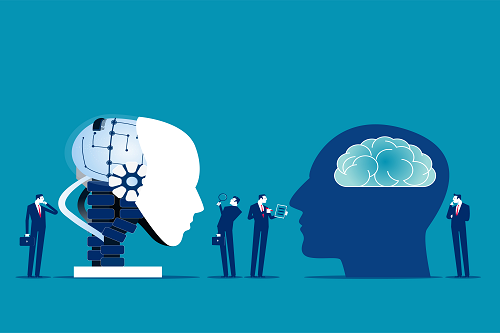
Many organizations are approaching artificial intelligence (AI) with a deceptively simple objective: How many people can this technology replace?
That may be the wrong question.
The more valuable question is: How much more impact could our people make if AI were paired with stronger critical thinking, sound judgment, and human experience?
AI can process enormous amounts of information, recognize patterns, generate options, and complete certain tasks with remarkable speed. But producing an answer is not the same as understanding a problem. Speed is not judgment. Confidence is not accuracy. And a plausible response is not necessarily a wise one.
If organizations want to realize AI’s full potential, they may need more human thinking, not less.
The risk of surrendering judgment
People often accept information produced by technology because technology appears objective. When an AI response is immediate, polished, and authoritative, it can feel more reliable than it is.
This creates a dangerous dynamic: the less confident people are in their own reasoning, the more likely they may be to accept the machine’s answer without examining it.
We already see signs of declining patience for the slower disciplines of thinking: questioning assumptions, evaluating evidence, considering competing explanations, and sitting with ambiguity. This is especially noticeable among people who have grown up with instant access to information, although it is certainly not limited to any generation.
Easy access to answers can disguise a lack of understanding.
AI intensifies this problem because it rarely behaves like a search engine that simply presents information. It synthesizes, recommends, explains, and sometimes persuades. Its answers can become a kind of digital Magic 8 Ball: people ask a question, receive an answer, and interpret that answer through the lens of what they already hoped or expected to hear.
Like a horoscope, a sufficiently broad or agreeable response can feel personally meaningful. We see in it what we want to see.
That is not artificial intelligence replacing human bias. It is artificial intelligence amplifying it.
Consider a few questions
Would you allow AI to run the government?
Would you hand it complete responsibility for creating your organization’s strategy?
Would you ask it to give you daily instructions for raising your child?
Would you allow it to make your most consequential life choices?
Most leaders would probably answer no, or, at minimum, “not without meaningful human oversight.”
Why? Because these decisions require more than information. They involve values, culture, context, accountability, relationships, trade-offs, and consequences. They require someone to decide not only what can be done, but what should be done.
The same principle applies to organizational decisions, even when the stakes are less dramatic. AI can identify patterns in customer behavior, but it does not carry responsibility for how customers are treated. It can recommend workforce reductions, but it does not experience the human or cultural consequences. It can draft a strategy, but it does not possess a leader’s lived understanding of the organization, its people, or its purpose.
AI can contribute to a decision. It cannot own the responsibility for it.
Replacement is a limited ambition
This is why the eagerness of some large and respected organizations to replace people with AI deserves scrutiny.
Cost reduction is measurable and immediate. Human potential is harder to quantify. Replacing a role can produce a clear line on a financial report; augmenting a person’s judgment, creativity, and productivity may take longer to demonstrate.
But replacement can also remove the very capabilities that make AI useful: contextual knowledge, healthy skepticism, ethical judgment, empathy, imagination, and accountability.
An organization that automates faster than its people learn to think may become more efficient while becoming less intelligent.
The better opportunity is not simply to remove humans from the work. It is to redesign the work so that people and AI each contribute what they do best.
Let AI rapidly analyze information, test possibilities, expose patterns, summarize complexity, and challenge first drafts. Let people establish purpose, question assumptions, recognize nuance, weigh consequences, and make accountable decisions.
The strongest combination is neither humans alone nor AI alone. It is capable people, equipped with better thinking skills, working intelligently with capable tools.
A leadership responsibility
Leaders should treat critical thinking as essential AI infrastructure.
Investing in technology without investing in people’s reasoning skills is like buying advanced machinery without training anyone to operate it safely. Employees need to know how to challenge an AI-generated answer, verify its claims, detect missing context, recognize bias, and distinguish a persuasive response from a sound conclusion.
They also need permission to disagree with the machine.
The organizations that benefit most from AI will not necessarily be those that eliminate the most jobs or generate the fastest answers. They will be those that develop people who can ask better questions, evaluate answers more rigorously, and apply human judgment where it matters most.
AI should expand our capacity to think, not become an excuse to stop thinking.
Powerful technology and more capable human judgment is where the real competitive advantage will be found.
Ready to build a smarter AI strategy?
Let’s talk about creating an AI strategy that strengthens human judgment, not replaces it.

Adam is a Senior Consulting Associate of Strategy Management Group/Balanced Scorecard Institute and a business strategy and digital transformation leader with over 15 years of consulting experience driving solutions and has served in management & leadership positions. Adam has a history of solving challenging, global process problems by applying appropriate agile and lean adaptive frameworks to drive recommendations. In addition, he has led various collaborative projects that made his recommendations a reality.